
Agency tools that creators use and brands trust.
Creator pricing and brand deal management, built for gaming.
Investor DeckGaming creators and their agencies have never had the right tools, and brands outside gaming have no way to see what any of it is worth.
“Content creation is still in its infancy. I've always wanted something like this.”
“I want to centralize everything.”
“There's a massive difference between a creator that just blew up and an established creator. Brands constantly overpay the wrong creator.”
SPCTR is built by a founder who has run gaming creator agencies. The product comes from inside the problem.
Investor DeckSPCTR is one connected workflow for agencies and their creators.
The work moves through one system instead of spreadsheets and DMs. Three connected sides (agency, creator, brand) see the same data and the same workflow. Brand portal goes live June 15.
A brand campaign lands with the agency.
The campaign is broken into briefs and pushed to creators in two clicks.
Each creator works from their command center, with the SPCTR Coach alongside.
Every post's results return to the creator and the agency. The report writes itself.
One system. Three connected sides. The work stops living in DMs and spreadsheets.
Investor DeckOne product. Three connected portals. Built for the whole agency.
Run the business
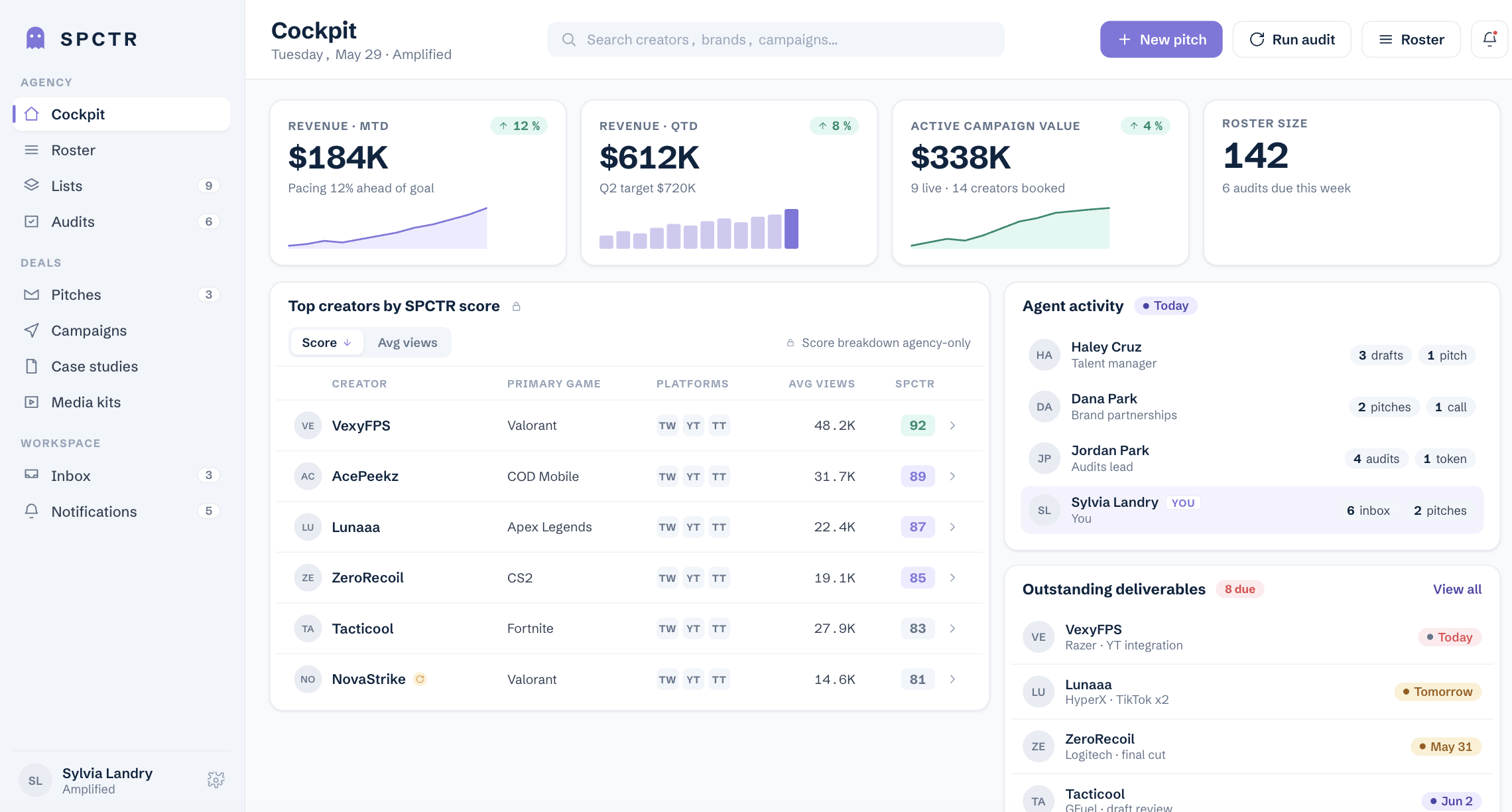
- The full creator roster with live cross-platform analytics
- Campaigns broken into briefs, assigned in two clicks
- Deal pipeline and campaign reporting from real posted content
Run the content
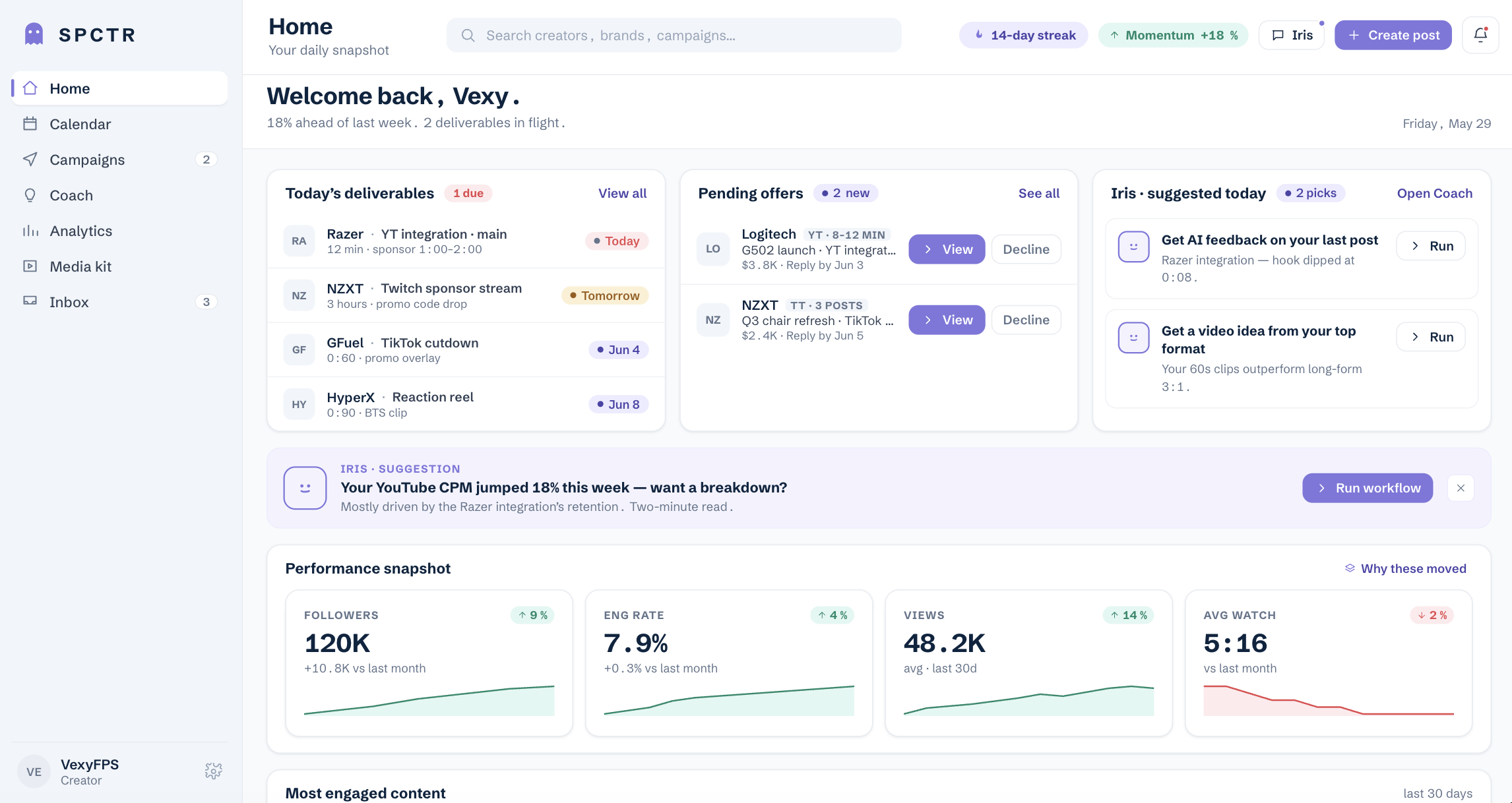
- A content calendar, daily briefing, and assigned briefs in one queue
- The SPCTR Coach running on their own numbers
- An auto-built media kit and SPCTRscore
See what you're buying
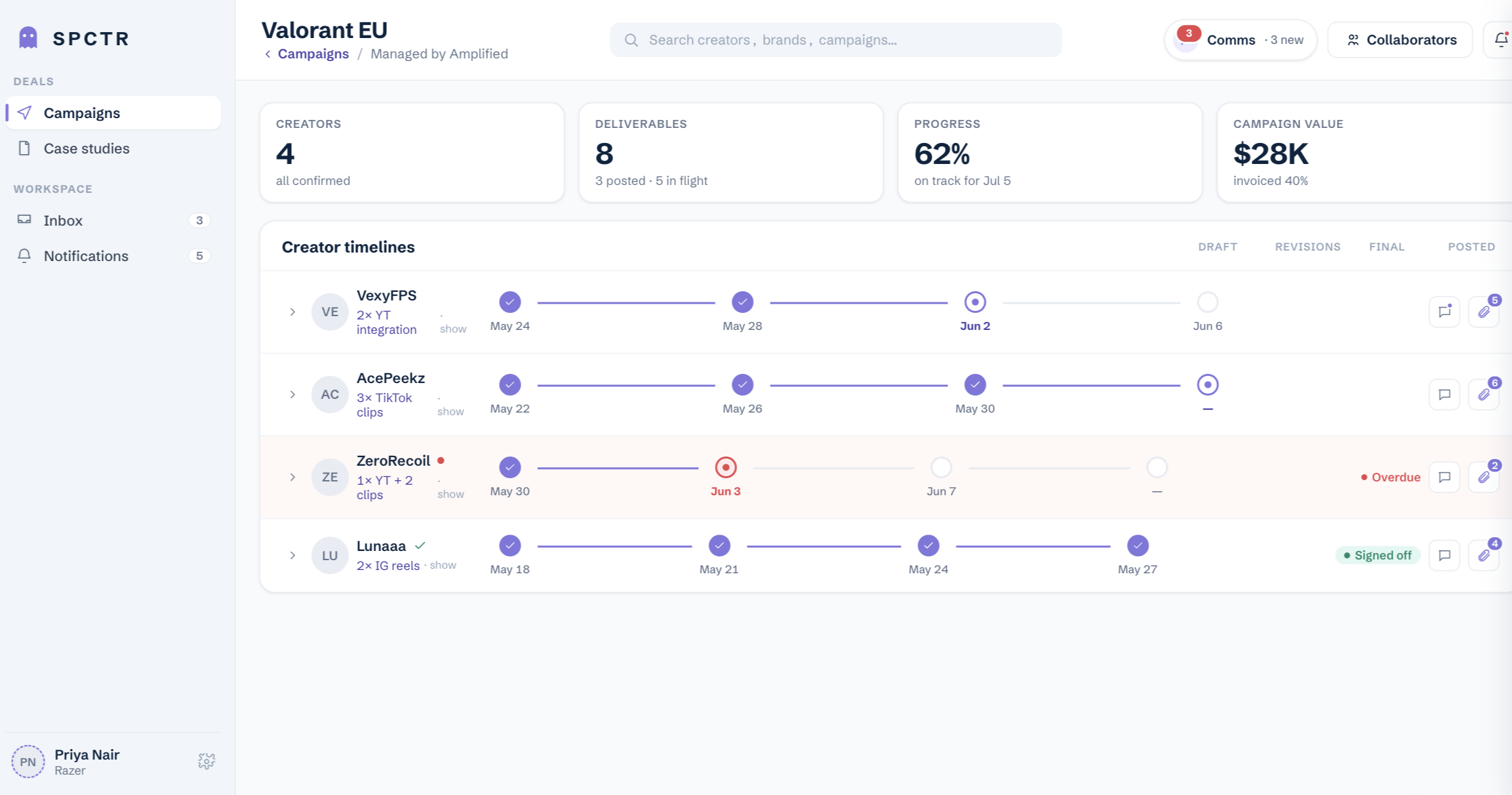
- A read-only campaign view for the brands the agency serves
- Live progress, deliverable previews, and post-mortem reports in one link
- No data export, no self-serve queries. Agency stays the gatekeeper.
Investor DeckSPCTRscore, the Pricing Engine, and the Coach get sharper every time both sides use SPCTR.
Every signed agency brings its roster onto the platform with authorized cross-platform data. Every creator on the roster adds more. The three capabilities below improve as that activity accumulates.
A live market price
Every creator scored against the live market, not against follower count. As the industry moves, the score moves. Agencies and creators always know what a creator is worth.
Game, niche, persona, risk
Live today. Every gaming creator deal priced by game, niche, persona, and risk, from authorized roster data we collect. Generic tools cannot reach this because they do not have the data. Once SPCTR is the number, the category opens to brand spend that currently stays away.
The expert neither side could afford to hire
SPCTR Coach answers the questions both sides actually ask: should I take this deal, what should I post next week, where is my creator's performance trending. It runs on the live SPCTR data underneath, so the answers reference the agency's and creator's real numbers, not generic advice.
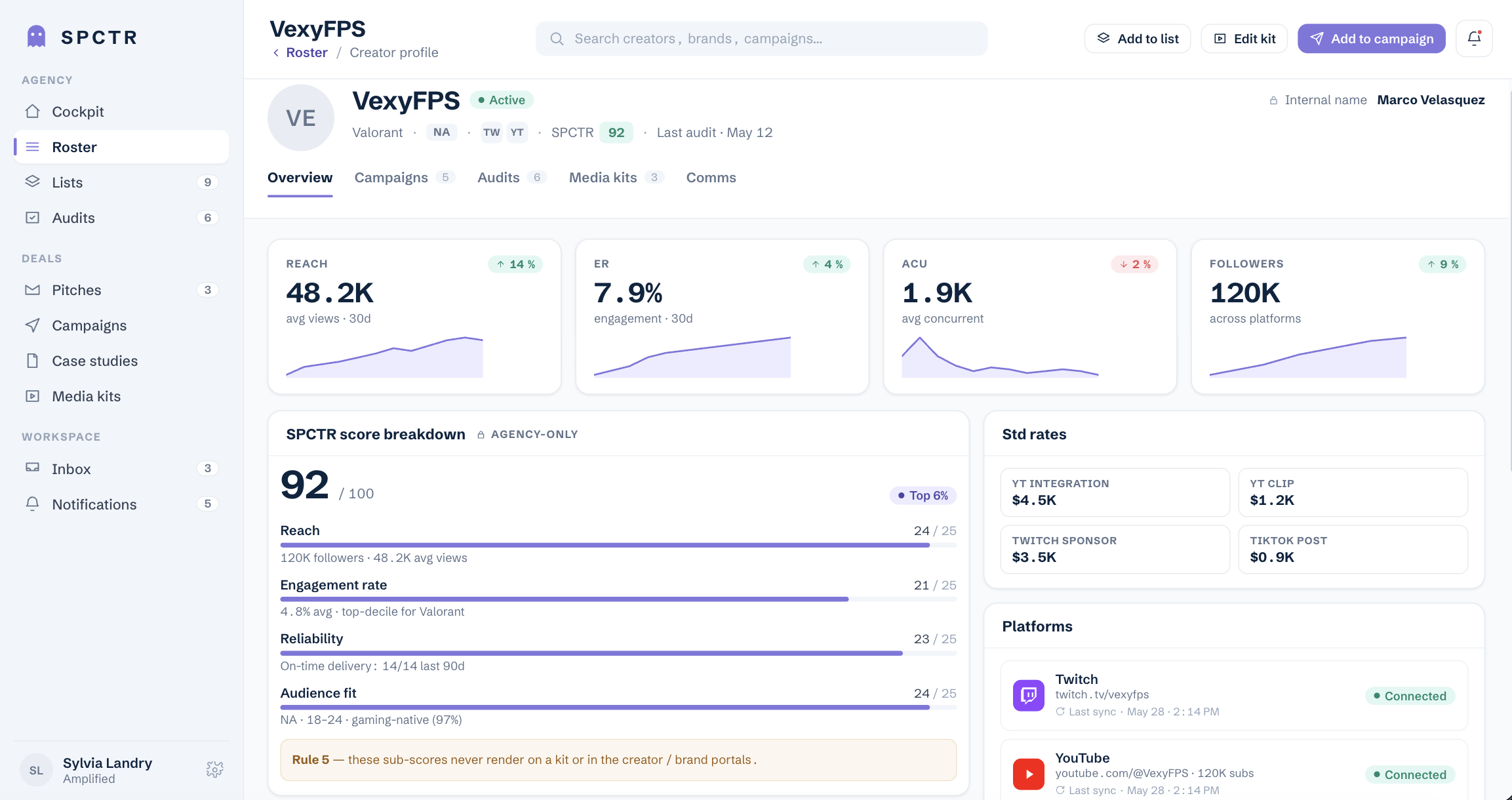
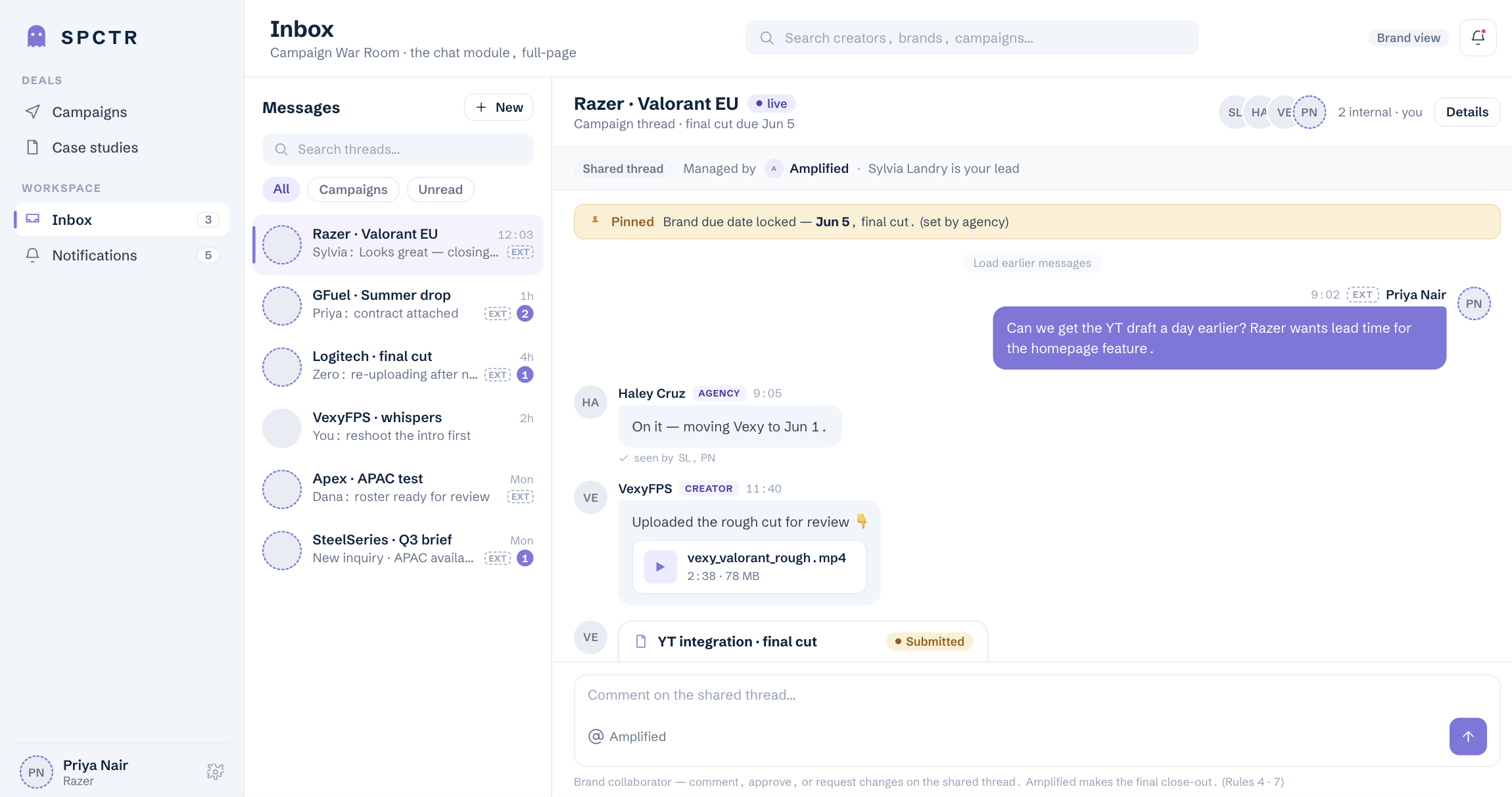
Both the agency and the creator run their daily work inside SPCTR: briefs assigned, content scheduled, deals tracked, cross-platform performance pulled in. The longer that activity continues, the sharper the score, the price, and the Coach get. The moat that compounds on top of this is on the next slide.
Investor DeckThree things nobody catches up to by writing software faster.
Each one gets harder to reproduce with every customer SPCTR signs.
The buyers live in Discord
Gaming creator agencies live on Discord and Telegram. They don't list themselves on B2B directories. Amplified IM, our anchor, isn't on any. Pillar and Tagger can't reach this buyer.
Every signed agency adds more
Every signed agency brings its whole roster with cross-platform data. Brand-side tools can't see this layer because they sell to brands, and the data belongs to the agency.
Game, niche, persona, risk
The pricing engine values each deal on four inputs: the game, the creator's niche inside it, the creator's persona, and the risk in the work. Nobody else captures all four, because they don't have the roster data and can't get it from public sources.
Distribution lands the agency. The agency brings the roster, which produces the data that trains the pricing engine. None of it starts without the gaming network Pillar and Tagger don't have.
Investor DeckThe three tools a gaming creator agency actually compares us against.
For a gaming-industry audience, the real competition is not CreatorIQ or GRIN. It is the tools agencies actually evaluate when shopping for an operating layer.
Pillar.io
Talent agency product, live media kits, multi-creator roster management. General creator economy (UGC, beauty, fitness, coaches). Center of gravity is monetization (link-in-bio storefront, e-commerce). No gaming-native data model, no deterministic pricing, no brand-side workflow, no deal operations layer.
Linktree
Link-in-bio for individual creators. No agency layer. No roster management. No analytics depth. Solves a different problem.
Sprout Social Tagger
Influencer discovery and campaign management for brand teams, with adjacent agency and creator products. Pricing is industry-standard CPM by audience size. Creators don't actually use Tagger's creator product, so OAuth tokens go stale and the data drifts. Not gaming-native, not priced by game, niche, persona, and risk.
The gaming-native operating layer
Built for the agency-plus-roster middle, with a brand portal on top. Three-sided: Agency runs the business, Creator runs the content, Brand sees what they are buying. The pricing engine runs on authorized roster data the others cannot reach. Pillar cannot go gaming-native without rebuilding its core. Tagger cannot move into the agency seat without becoming a different company. Linktree is not trying to. Gaming-specific data, captured from all three sides. That is the moat.
Investor DeckFeature for feature, the gap is the gaming-native operating layer.
The same capabilities, across the three tools a gaming creator agency evaluates. No competitor covers all three sides for gaming agencies end to end.
| Capability | Pillar.iotalent agency | Linktreecreator-only | Sprout Taggerbrand-side | SPCTR |
|---|---|---|---|---|
| Gaming-native data model | — | — | — | ✓ |
| Multi-creator agency roster | ✓ | — | ~ | ✓ |
| Cross-platform creator analytics | ~ | — | ✓ | ✓ |
| Auto-built creator media kit | ✓ | ~ | — | ✓ |
| Campaign-to-brief assignment | — | — | ✓ | ✓ |
| Brand-side campaign portal | — | — | ✓ | ✓ |
| Deterministic AI coach | — | — | — | ✓ |
| SPCTRscore creator quality score | — | — | — | ✓ |
| Pricing engine (deal-level) | — | — | ~ | ✓ |
| Built for gaming agency as buyer | — | — | — | ✓ |
| Brings brand demand / deal sourcing | ~ | — | ✓ | — |
| Years of production deployment at scale | ✓ | ✓ | ✓ | ~ |
Investor DeckAmplified IM is live, and paying.

Amplified IM
A mobile-gaming creator agency with a 75+ creator roster. Signed and paying on a 12-month auto-renewing agreement. As the founding design partner, Amplified is on a lifetime-locked founding rate of $11K; standard pricing for all new agencies is $25-60K, and Year 1 projections assume the standard rate. In active deployment now, with the full roster onboarding.
15-creator pilot, complete
A hands-on pilot with 15 gaming creators, run primarily as guided sessions. It validated the problem and the workflow design, and surfaced the demand in the creators' own words below.
“Content creation is still in its infancy. I've always wanted something like this.”
“There's a massive difference between a creator that just blew up and an established creator. Brands constantly overpay the wrong creator.”
Investor DeckGaming creator marketing hit ad-buying maturity, and the operating layer is unbuilt.
Market size and growth per Mordor Intelligence, 2026.
Investor DeckA market that lives in Discord, with three buyer types on one platform.
Gaming creator economy: $28.6B in 2024, growing 23.2% CAGR to $230.4B by 2034 (Market.us). Three buyer types inside it.
~$5–20M reachable
Gaming-focused creator agencies worldwide, mostly in dark social. ACV anchors: Amplified at $11K founding rate, Stream Hatchet Pro $15K, GRIN Complete $21.6K, Sprout Advanced $24–48K.
~$39M data-licensing
~1,460 named org buyers want gaming media valuation: 1,076 esports leagues (Esports Charts), 84 IESF federations, 280 NACE programs, 10 publishers, 5 holdcos. ACV: Sensor Tower data licensing $30–150K (Vendr).
~$1–9M, plus the data input
Twitch reports 9.5M+ monthly streamers. SPCTR's $29/mo tier converts the pros, and the usage feeds Type 2. Comp: Streamlabs sold to Logitech for $89M plus $29M earnout.
A standard search of Influencer Marketing Hub, Crunchbase, and LinkedIn won't surface these agencies. I run one. I'm not on those directories. Our anchor Amplified IM isn't either. The directories are where our competitors sell, and that's the gap.
TAM: $45–70M, every input cite-able. SOM (3-year): $1.5–4.5M ARR from 50–150 agency contracts plus early valuation-licensing deals. Category exit: Sprout paid $140M cash for Tagger (SEC, August 2023).
Investor DeckAgency SaaS is the core. Creator freemium expands it.
Agency SaaS
A roster-based subscription, $25-60K a year, scaling with roster size. $25K is less than the cost of one hire; SPCTR earns it by freeing up roughly half a person of manual work.
Creator freemium
Free as agency seats, with a paid tier for individual creators. A built-in funnel and an expansion line.
Land the agency, the whole roster comes with it. These are software gross margins: serving another agency costs hosting and AI, a small fraction of the subscription. No ad spend, no marketplace take.
Investor DeckWhat $400K gets us to.
Over the next 15 months, the raise funds three things.
New agencies at the standard $25-60K, not the founding rate. That recurring revenue, plus a reference customer, is what makes SPCTR ready to raise a seed round. This is the near-term target, not a multi-year projection.
Investor DeckA path past $3M ARR by Year 3.
A bottom-up model built on signed-agency economics. Year 1 is founder-led; Year 2 is the inflection, when a seed round funds a GTM team; Year 3 reaches a Series A profile. Base case is the plan; upside assumes faster signings.
| Metric | Year 1this raise · founder-led | Year 2post-seed · GTM team | Year 3Series A ready |
|---|---|---|---|
| Ending paying agencies | 10upside 14 | 30upside 45 | 75upside 115 |
| Avg contract (blended) | ~$30K | ~$36K | ~$42K |
| Agency ARR | ~$300Kupside ~$440K | ~$1.1Mupside ~$1.7M | ~$3.2Mupside ~$5M |
| Gross margin | ~85% | ~88% | ~90% |
| Team headcount | 2 | 7–9 | 15–20 |
Agency SaaS only; the creator paid tier is unmodeled upside. Year 3's 75 agencies sits inside the gaming-focused agency universe we sell into, mostly in dark social (see Market slide). Avg contract shown is the base case. Year 1 begins with Amplified IM at its founding rate.
Investor DeckBuilt for this specific seat.
SPCTR is built by the person it is built for. Ben has run a creator marketing agency, sold the hardest buyer in B2B, and ships product faster than competitors can hire.


Ben built SPCTR to solve his own problem as an agency owner.
The first full-time engineering hire is the top use of this raise. Founder-market fit is the bet today; the raise builds the team around it.
Investor DeckWhat could break this, and what we are doing about it.
Three risks we are tracking. Calling them out beats waiting for the diligence call.
Longer than expected
Risk: agencies are slow to swap operating tools.
Mitigation: pricing well below a hire ($25K to $60K vs $80K-plus for an ops coordinator), 12-month agreements with founding-rate anchors, and the NXTE distribution partnership cutting acquisition cost.
Moves into gaming
Risk: Pillar pivots vertical and competes head-on.
Mitigation: Pillar's center of gravity is monetization (link-in-bio storefront), not operations. Their gaming-native rebuild requires changing core data architecture; ours is gaming-native day one. By the time they move, SPCTR has the wedge.
Model pricing risk
Risk: AI infrastructure costs spike, breaking unit economics.
Mitigation: SPCTR Coach is deterministic-workflow, not freeform LLM chat. AI usage is bounded and predictable per workflow. Gross margin stays at 85%-plus even under a 3x model cost increase.
Investor DeckThe ten-year picture.
SPCTR becomes the operating system for the creator marketing industry, owning the data layer that prices it. Three expansions, each unlocked by the one before it.
Three-sided platform
Agency, Creator, and Brand all run on SPCTR. The data loop closes: deals priced, executed, and measured in one system. The brand portal that launches June 2026 is step one of this expansion.
Premium marketplace
Vetted partners (production studios, lawyers, payment processors) accessible to the SPCTR network at platform-negotiated rates. SPCTR takes a cut of partner revenue. Margin without marketplace risk.
Data licensing and vertical expansion
SPCTR's pricing data becomes the industry benchmark, licensed to enterprise buyers and analyst firms. The same platform model extends to other performer verticals (sports, fitness, music), where the same problem exists: high-output talent with no operating infrastructure.
The bet: build the price, own the data, expand the verticals.
Investor Deck$400K to serve Amplified, ship the Brand Portal, and sign roughly ten gaming agencies.
We are raising $400K on a post-money SAFE at a $4M cap. About 15 months of runway. The plan: make the first engineering hire, complete the brand-side build with design partner NXTE, and sign roughly ten gaming agencies at standard pricing.
This is a gaming-vertical raise. Every dollar pushes deeper into the wedge. The round carries SPCTR to seed-ready: a base of paid gaming agencies, the brand-side platform live and producing real campaign data, and proof the model repeats outside the anchor. SPCTR takes 15% of sponsor revenue flowing through the NXTE-side product, projected upside roughly $40K in Year 1 and $110K in Year 2, none of which is in the financial projections.
Investor Deck